
Showing posts with label college. Show all posts
Showing posts with label college. Show all posts
Tuesday, August 27, 2019
Carrtoones


Saturday, June 15, 2019
Flashback Saturday: College Graduation Edition

Thursday, April 18, 2019
30 YEARS AGO TODAY ...

Tuesday, March 05, 2019
Twen. Ty.


Friday, December 21, 2018
Thirty years ago today ...
I’d finished my classes for the semester and my dad had come to pick me up from college for the holiday break. 1988 had been an emotional roller coaster for our family. We’d lost four family friends in a small plane crash Easter morning, my mom had undergone a radical mastectomy in October and she was just starting her first rounds of chemo before Christmas. I was in the middle of my junior year in college, and I’d finally found a major I was willing to stick with: English. But since I’d waited a full two years to admit to myself I always should have been an English major, I had a lot of catching up to do. And my first-semester courseload had been heavy.
December 21 is the winter solstice—the day of the year with the shortest amount of sunlight—but it was beautiful and sunny in Eastern Iowa that afternoon in 1988. And Dad and I had a nice chat over the 40-minute drive home. My family has always been close, so when we saw Mom standing in the driveway as we pulled up to the house, I figured she was just excited to see me.
But she was sobbing.
I assumed she’d gotten some bad news about her cancer while Dad was gone, so I jumped out of the car before it even came to a stop and I ran up to hug her. But the bad news was something entirely different ... something so random and so unexpected that the shock of the words literally didn't make sense to me: Miriam’s plane had gone down.
Miriam was a friend of mine who had spent the 1988 autumn semester in London studying under the auspices of Syracuse University. I’d just visited her over the Thanksgiving break, and we’d had an awesome time seeing the sights, exploring the museums and taking in all the shows we could afford on our college-student budgets. Among the four we saw were Les Misérables and what ended up being a definitive revival of Stephen Sondheim’s Follies. Sondheim was just starting to appear on our collective radar, and we both agreed that seeing Follies together was a mountaintop experience for us to have shared over our magical week together in London.
But by December 21, I’d come home, a whole month had passed and I’d been so caught up in my finals and holiday preparations that I’d had no idea Miriam was flying back to the States that day—much less what flight she was on. Neither had my mom. But our friend Jody in Ohio did. And when the initial reports that Pan Am flight 103 had disappeared out of the sky over Lockerbie, Scotland, started washing over the newswires, Jody had called everyone she could think of.
Mom and Dad and I raced to the family room and crowded around the TV that crisp, sunny Iowa afternoon to see what we could find out about Miriam’s plane. It was the early days of CNN and 24-hour news, so we were able to get (spotty) information right away about the mysterious crash, along with grainy images of the wreckage shining dimly in the emergency lights that were working so hard to pierce the solstice blackness six time zones away. Dimly seeing what we could of it and haltingly learning more and more about it over the next hours was at once horrifying and comforting, filling us with both hopefulness and helplessness.
Over the next few months and weeks, the world came to learn about the bomb, the Libyans, the retribution, the embargoes, the bankruptcies. We cautiously wrapped our brains around the unthinkable efficiencies of global terrorism at the dawn of the Information Age. And the friends and families of the victims of the 103 bombing started experiencing the bizarre dichotomy of watching our personal tragedy play itself out on the world stage.
In the years since Miriam’s murder, I’ve befriended her parents and friends. I’ve gotten in touch with the roommates she lived with in London, none of whom had been on her plane with her that day. I’ve written pieces about my relatively removed perspective on the bombing that were published in newspapers and scholarly journals and read on NPR. And since I had been in London and had hung out with a lot of the murdered Syracuse students a month before the bombing, I’ve actually been interviewed by the FBI.
And as I’ve grieved and matured over the last thirty years, I’ve discovered that I now tend to be efficiently emotionless when I hear about catastrophic tragedies like the 9/11 attacks and the Stoneman Douglas massacre and the devastating 2018 wildfires ... though I’ll still burst into tears over emotional pablum like Christmas cookie commercials.
Thirty years ago today, the world learned what a volatile mix misanthropy and religion and blind nationalism can be in a global melting pot.
Thirty years ago today, Miriam and her fellow passengers and their families and friends learned violently and unwillingly about harsh brutalities that the rest of the world got the relative luxury of absorbing over time.
Thirty years ago today, I learned that the distant tragedies that so often happen to “other people” should never be observed as abstractions.
I discovered that news of plane crashes and acts of terrorism that play endlessly in 24-hour news cycles can be both disturbing and strangely comforting. I learned that life is precious, that there are no guarantees, that people who waste your time are robbing you of a precious and very limited possession, that small gestures can make heroic impressions, that your pain and suffering and anguish and heartbreak both do and don't make you special, that no matter how bad it gets you should work to find solace in the fact that it will probably get better … or at least easier.
Thirty years is enough time for someone to raise a child and send him or her off into the world. Enough time for eight presidential elections and four new Sondheim musicals. (Six, if you count Saturday Night and The Frogs.)
It’s enough time for a gangly, unsure college boy to cycle through four cars and eight houses and eight jobs and three cities as he grows into a successful (more or less), confident (more or less) man.
It’s enough time for him to realize that the world is not fair. That bad things happen to good people. That the bad people who did them don’t always get punished. That horrible tragedy gets easier to accept over time, even though it remains impossible to forget. That the hate that some people burn into your heart never entirely leaves ... and that the smug, satisfied self-righteousness you experience when you finally see images of the bloodied, abused corpse of Moammar Gadhafi—who denied to his last hopefully excruciating, terrified breath every credible report that he'd ordered the Pan Am bombing—feels powerfully good.
I often wonder what Miriam would be if she were alive today. Tony-winning actor? International journalist? Have-it-all mom? She was among those people you just knew were going somewhere big with their lives. I’m sure that wherever the fates would have taken her, she’d be someone people knew about.
I also wonder if we would still be friends. We’d met that summer when we were singing and dancing in the shows at Darien Lake amusement park just outside Buffalo, New York. Our friendship lasted just seven months until she was murdered. I’m only barely in touch with the other friends I made at the park that summer. Miriam’s family and I aren’t in touch nearly as much as I’d like either (though her mother recently published a book of Miriam's writings along with essays from people who knew and loved her, including me).
Would Miriam and I have drifted apart as well?
Since at this point I’m the only one in control of our story, I choose to believe that by now I’d have sung in her wedding and befriended her kids on Facebook and marched in pink hats with her in Washington and lost countless hours texting ridiculous memes back and forth with her.
And I’m pretty sure she’d have written the same story for me if our fates had been reversed.
Thirty years ago today was the last, devastating act in a year that had shaken—and strengthened—my family to its core. It was the day my worldview changed from naive to guarded, from optimistic to cynical, from insular to secular.
It was the day my friend Miriam was murdered.
And it was just another day for most people.
And though the world continues to spin forward—as it should—and people’s memories continue to fade—as they do—I will never forget.

December 21 is the winter solstice—the day of the year with the shortest amount of sunlight—but it was beautiful and sunny in Eastern Iowa that afternoon in 1988. And Dad and I had a nice chat over the 40-minute drive home. My family has always been close, so when we saw Mom standing in the driveway as we pulled up to the house, I figured she was just excited to see me.
But she was sobbing.
I assumed she’d gotten some bad news about her cancer while Dad was gone, so I jumped out of the car before it even came to a stop and I ran up to hug her. But the bad news was something entirely different ... something so random and so unexpected that the shock of the words literally didn't make sense to me: Miriam’s plane had gone down.
Miriam was a friend of mine who had spent the 1988 autumn semester in London studying under the auspices of Syracuse University. I’d just visited her over the Thanksgiving break, and we’d had an awesome time seeing the sights, exploring the museums and taking in all the shows we could afford on our college-student budgets. Among the four we saw were Les Misérables and what ended up being a definitive revival of Stephen Sondheim’s Follies. Sondheim was just starting to appear on our collective radar, and we both agreed that seeing Follies together was a mountaintop experience for us to have shared over our magical week together in London.
But by December 21, I’d come home, a whole month had passed and I’d been so caught up in my finals and holiday preparations that I’d had no idea Miriam was flying back to the States that day—much less what flight she was on. Neither had my mom. But our friend Jody in Ohio did. And when the initial reports that Pan Am flight 103 had disappeared out of the sky over Lockerbie, Scotland, started washing over the newswires, Jody had called everyone she could think of.
Mom and Dad and I raced to the family room and crowded around the TV that crisp, sunny Iowa afternoon to see what we could find out about Miriam’s plane. It was the early days of CNN and 24-hour news, so we were able to get (spotty) information right away about the mysterious crash, along with grainy images of the wreckage shining dimly in the emergency lights that were working so hard to pierce the solstice blackness six time zones away. Dimly seeing what we could of it and haltingly learning more and more about it over the next hours was at once horrifying and comforting, filling us with both hopefulness and helplessness.
Over the next few months and weeks, the world came to learn about the bomb, the Libyans, the retribution, the embargoes, the bankruptcies. We cautiously wrapped our brains around the unthinkable efficiencies of global terrorism at the dawn of the Information Age. And the friends and families of the victims of the 103 bombing started experiencing the bizarre dichotomy of watching our personal tragedy play itself out on the world stage.
In the years since Miriam’s murder, I’ve befriended her parents and friends. I’ve gotten in touch with the roommates she lived with in London, none of whom had been on her plane with her that day. I’ve written pieces about my relatively removed perspective on the bombing that were published in newspapers and scholarly journals and read on NPR. And since I had been in London and had hung out with a lot of the murdered Syracuse students a month before the bombing, I’ve actually been interviewed by the FBI.
And as I’ve grieved and matured over the last thirty years, I’ve discovered that I now tend to be efficiently emotionless when I hear about catastrophic tragedies like the 9/11 attacks and the Stoneman Douglas massacre and the devastating 2018 wildfires ... though I’ll still burst into tears over emotional pablum like Christmas cookie commercials.
Thirty years ago today, the world learned what a volatile mix misanthropy and religion and blind nationalism can be in a global melting pot.
Thirty years ago today, Miriam and her fellow passengers and their families and friends learned violently and unwillingly about harsh brutalities that the rest of the world got the relative luxury of absorbing over time.
Thirty years ago today, I learned that the distant tragedies that so often happen to “other people” should never be observed as abstractions.
I discovered that news of plane crashes and acts of terrorism that play endlessly in 24-hour news cycles can be both disturbing and strangely comforting. I learned that life is precious, that there are no guarantees, that people who waste your time are robbing you of a precious and very limited possession, that small gestures can make heroic impressions, that your pain and suffering and anguish and heartbreak both do and don't make you special, that no matter how bad it gets you should work to find solace in the fact that it will probably get better … or at least easier.
Thirty years is enough time for someone to raise a child and send him or her off into the world. Enough time for eight presidential elections and four new Sondheim musicals. (Six, if you count Saturday Night and The Frogs.)
It’s enough time for a gangly, unsure college boy to cycle through four cars and eight houses and eight jobs and three cities as he grows into a successful (more or less), confident (more or less) man.
It’s enough time for him to realize that the world is not fair. That bad things happen to good people. That the bad people who did them don’t always get punished. That horrible tragedy gets easier to accept over time, even though it remains impossible to forget. That the hate that some people burn into your heart never entirely leaves ... and that the smug, satisfied self-righteousness you experience when you finally see images of the bloodied, abused corpse of Moammar Gadhafi—who denied to his last hopefully excruciating, terrified breath every credible report that he'd ordered the Pan Am bombing—feels powerfully good.
I often wonder what Miriam would be if she were alive today. Tony-winning actor? International journalist? Have-it-all mom? She was among those people you just knew were going somewhere big with their lives. I’m sure that wherever the fates would have taken her, she’d be someone people knew about.
I also wonder if we would still be friends. We’d met that summer when we were singing and dancing in the shows at Darien Lake amusement park just outside Buffalo, New York. Our friendship lasted just seven months until she was murdered. I’m only barely in touch with the other friends I made at the park that summer. Miriam’s family and I aren’t in touch nearly as much as I’d like either (though her mother recently published a book of Miriam's writings along with essays from people who knew and loved her, including me).
Would Miriam and I have drifted apart as well?
Since at this point I’m the only one in control of our story, I choose to believe that by now I’d have sung in her wedding and befriended her kids on Facebook and marched in pink hats with her in Washington and lost countless hours texting ridiculous memes back and forth with her.
And I’m pretty sure she’d have written the same story for me if our fates had been reversed.
Thirty years ago today was the last, devastating act in a year that had shaken—and strengthened—my family to its core. It was the day my worldview changed from naive to guarded, from optimistic to cynical, from insular to secular.
It was the day my friend Miriam was murdered.
And it was just another day for most people.
And though the world continues to spin forward—as it should—and people’s memories continue to fade—as they do—I will never forget.

Sunday, July 22, 2018
I went to the Daily Iowan 150th anniversary reunion this weekend
and aside from reconnecting with old friends and colleagues and being reminded how proud I should be to have been a part of the paper’s noble and influential history, all I got was this awesome T-shirt:


Saturday, July 21, 2018
Cake I like

1. I just left the 150th anniversary celebration/reunion of alumni of the University of Iowa’s Daily Iowan newspaper
2. Which has been and continues to be one of the country’s foremost influential and innovation-vanguard college newspapers 3. With AP accreditation and everything
4. As you might have inferred from my use of the word alumni in point 1, I worked there when I attended the University of Iowa
5. First as a copy editor
6. Which means proofreading and fact-checking nerd
7. Then as copy desk editor
8. Which means head proofreading and fact-checking nerd
9. I got paid to correct people’s grammar
10. And brutally curtail their garish use of excessive, showy punctuation
11. Grammar. Nerd. Power. Trip.
12. Though this probably explains why I’m single and living in my parents’ basement at the age of 50
13. And destined to die alone
14. I also wrote a weekly grammar column for the Daily Iowan
15. Seriously
16. It was called "That Grammar Guy"
17. The name was inspired by the TV show That Girl
18. I am not making this up
19. It used bizarre humor, recurring characters—including a cat named Xanthippe—and my own—hopefully funny—mnemonic devices to explain English grammar
20. Xanthippe was Socrates’ wife
21. But I used the name because I thought it was funny and not for its ties to any concept of learning
22. Mnemonic means "memory-aiding"
23. The m is silent
24. The first one, I mean
25. You’re welcome
26. Anyway ...
27. "That Grammar Guy" ran in the Daily Iowan every Monday for two years
28. I got fan mail
29. Mostly from foreign students who were struggling to learn our crazy-ass melting-pot language
30. I also reviewed theater, music and dance for the Daily Iowan
31. So my work there was both nerdy and gay
32. In my capacity as copy desk editor, I hired my brilliant and delightful friend Annette
33. I got to sit next to her at tonight’s dinner
34. Where it occurred to me that everyone in the room—and every career path we represented—was there based on an intricate genealogy of hiring decisions
35. Mind. Blown.
36. I also sat by my friend Tad, who is at least four years younger than I am
37. We didn’t work together at the DI, so I have no proof that he wasn’t at tonight’s dinner just for the pork and the really delicious ranch dressing
38. Speaking of, I didn’t notice until after I sat at our table that each seat had been pre-assigned a random dessert selection
39. I’m glad I accidentally sat in front of the chocolate cake, because it was insanely delicious
40. I noticed early on that Annette probably wasn’t going to finish hers, and I will go to my grave regretting that I did not ask her if I could have it if she was done ignoring its insane deliciousness
41. My running buddy Rob was also at our table but he left before the evening’s program was over so I barred him from being in our post-program group selfie
42. Long-lost friend Jamie wasn’t at our table but he came over to say hi after the program so he’s my new selfie buddy in place of Leavin’ Rob
43. The keynote speaker for the program was a man who hadn’t given me a job right after I’d graduated from college
44. EVEN THOUGH WE WERE BOTH IN THE ETERNAL BROTHERHOOD OF THE IOWAN THAT IS DAILY
45. But he told a story about marketing tampons to young Russian women tonight, so I guess it’s time I forgave and forgot
46. Tampons
47. Russian women
48. Yes, THAT old cliché
49. So there was this one guy who wrote editorials at the DI when I was there
50. Dark hair, lean, handsome, smart, old-money patrician air
51. Did I mention handsome?
52. This might surprise you given the dearth of hints I’ve provided leading up to this bombshell, but I had a huge crush on him
53. Especially on the days when he wore shorts
54. The crush was so eternal and all-consuming that I’ve completely forgotten his name by now
55. But obviously not his legs
56. This did not stop me, however, from hoping he’d be there tonight
57. And that we’d flirt awkwardly
58. Which is the only way I know how to
59. And then we’d totally make out
60. Oops. Did I just say that?
61. And then instead of sitting here typing this endless post, I’d be marrying him in the DI newsroom
62. With everyone at the reunion cheering for us
63. And fighting each other for exclusive coverage of our wedding
64. (We are all newspaper people, of course)
65. And, of course, in this scenario I’d also get Annette’s leftover cake
66. Plus everyone else’s
67. Because I’m one of the grooms and DON’T RUIN MY BIG DAY BY EATING ALL MY CAKE, PEOPLE
68. Sheesh
69. Journalism people, amirite?
70. Anyway, I didn’t see anyone there tonight who looked like him
71. But none of the guys had any legs out for inspection
72. So here I sit, writing this long-ass post instead
73. Which I’d kinda hoped would stretch to 150 points
74. Because it’s the 150th anniversary of the paper
75. But no
Saturday, July 14, 2018
This stabble genus musta missed Spelling Day at Trump University:

Her hand clenching a sweat-stained burner cell phone and her neck limber and fully rotational as she scours her habitat searching for black people exhibiting the brazen audacity to exist in the suffocating mire of her personal magasphere, she crunches her face in a bitter rictus and brays in her deafening shriek about her white-shaming victimization. Even though she’s not actually capable of making it all the way through five-syllable words like victimization.
Saturday, July 07, 2018
This stabble genus musta missed Spelling Day at Trump University:

Her hand clenching a sweat-stained burner cell phone and her neck limber and fully rotational as she scours her habitat searching for black people exhibiting the brazen audacity to exist in the suffocating mire of her personal magasphere, she crunches her face in a bitter rictus and brays in her deafening shriek about her white-shaming victimization. Even though she’s not actually capable of making it all the way through five-syllable words like victimization.
Friday, April 20, 2018
Flashback Friday: Milestone Birthdays Edition

I’m not sure what’s most disturbing about this picture: the bar mitzvah clown smile, the Disney villain eyes, the dinner-plate glasses, the scarecrow neck, the weird-ass way I wore my watch on the inside of my wrist or the pink-on-white shirt that hung on me with all the sex appeal of a Mayan burial gown on an immolated corpse. The girls on my floor (Loser alert! I was living in the Foreign Language House, a co-ed dorm filled with language dorks who stayed in on Friday nights studying verb declensions!) had decorated my door with pink 21s. Probably to match the shirt. Or the homosexuality. I’m not sure where I got the wine, but I am sure I had only a sip of it to celebrate reaching such a milestone age. Because actually drinking a whole glass of alcohol on my 21st birthday would have been something the cool kids would do.
Thursday, March 29, 2018
I read Flesh and Blood by Michael Cunningham years ago in a book club in Chicago

Even though I was an English major in college I'd pretty much lost all interest in reading fiction by then -- and still to this day -- preferring instead to bury myself in books about social science and American and European history. But I DEVOURED this book for our book club. Then a couple years later I devoured it again. And for some reason, something reminded me of it a couple weeks ago. Then I had an opportunity to bring it up in a conversation soon afterward. And now I want to devour it a third time. If I still own my original copy, it's currently filed away in one of more boxes than I can count in my climate-controlled storage locker across town. So I ordered another copy and it arrived last week. And I can't wait to devour it again -- and since I've decided to forgo being in shows all summer so I can focus on training for all the Running Away From Being 50 races I want to do, I'm also going to attack the piles of books I've purchased over the last few years but have yet to even alphabetize by author on my shelves. Because that's how I roll.
Anyway, in Flesh and Blood Cunningham crafts a richly complex family narrative that germinates literally from the imagination of an eight-year-old boy as he plays in his father's garden in pre-war Greece. That boy -- mightily named Constantine Stassos -- eventually emigrates to America, marries an Italian immigrant, and becomes the imperious and by degrees powerless patriarch of an expanding family dynasty whose story is told both as a beautifully messy, eminently human drama and as a faceted metaphor for the American Dream filtered through a prism of post-war immigration, the uncertain but dogged progress of cultural assimilation, and the inconstantly evolving boundaries of familial love and obligation. It's as engrossing as it is complex, and as beautiful as it is essentially American.
Wednesday, January 17, 2018
Platelets!

My dad sold dinnerware door-to-door in college, and he carried tiny, adorable little plate samples with him to show potential customers the available patterns. The tiny, adorable little plate samples somehow just resurfaced in our house, and I can hardly stand how cute they are.
Thursday, December 21, 2017
Twenty-nine years ago today
I’d finished my classes for the semester and my dad had come to pick me up from college for the holiday break. 1988 had been an emotional roller coaster for our family. We’d lost four family friends in a small plane crash Easter morning, my mom had undergone a radical mastectomy in October and she was just starting her first rounds of chemo before Christmas. I was in the middle of my junior year in college, and I’d finally found a major I was willing to stick with: English. But since I’d waited a full two years to admit to myself I always should have been an English major, I had a lot of catching up to do. And my first-semester courseload had been heavy.
December 21 is the winter solstice—the day of the year with the shortest amount of sunlight—but it was beautiful and sunny in Eastern Iowa that afternoon in 1988. And Dad and I had a nice chat over the 40-minute drive home. My family has always been close, so when we saw Mom standing in the driveway as we pulled up to the house, I figured she was just excited to see me.
But she was sobbing.
I assumed she’d gotten some bad news about her cancer while Dad was gone, so I jumped out of the car before it even came to a stop and I ran up to hug her. But the bad news was something entirely different ... something so random and so unexpected that the shock of the words literally didn't make sense to me: Miriam’s plane had gone down.
Miriam was a friend of mine who had spent the 1988 autumn semester in London studying under the auspices of Syracuse University. I’d just visited her over the Thanksgiving break, and we’d had an awesome time seeing the sights, exploring the museums and taking in all the shows we could afford on our college-student budgets. Among the four we saw were Les Misérables and what ended up being a definitive revival of Stephen Sondheim’s Follies. Sondheim was just starting to appear on our collective radar, and we both agreed that seeing Follies together was a mountaintop experience for us to have shared over our magical week together in London.
But by December 21, I’d come home, a whole month had passed and I’d been so caught up in my finals and holiday preparations that I’d had no idea Miriam was flying back to the States that day—much less what flight she was on. Neither had my mom. But our friend Jody in Ohio did. And when the initial reports that Pan Am flight 103 had disappeared out of the sky over Lockerbie, Scotland, started washing over the newswires, Jody had called everyone she could think of.
Mom and Dad and I raced to the family room and crowded around the TV that crisp, sunny Iowa afternoon to see what we could find out about Miriam’s plane. It was the early days of CNN and 24-hour news, so we were able to get (spotty) information right away about the mysterious crash, along with grainy images of the wreckage shining dimly in the emergency lights that were working so hard to pierce the solstice blackness six time zones away. Dimly seeing what we could of it and haltingly learning more and more about it over the next hours was at once horrifying and comforting, filling us with both hopefulness and helplessness.
Over the next few months and weeks, the world came to learn about the bomb, the Libyans, the retribution, the embargoes, the bankruptcies. We cautiously wrapped our brains around the unthinkable efficiencies of global terrorism at the dawn of the Information Age. And the friends and families of the victims of the 103 bombing started experiencing the bizarre dichotomy of watching our personal tragedy play itself out on the world stage.
In the years since Miriam’s murder, I’ve befriended her parents and friends. I’ve gotten in touch with the roommates she lived with in London, none of whom had been on her plane with her that day. I’ve written pieces about my relatively removed perspective on the bombing that were published in newspapers and scholarly journals and read on NPR. And since I had been in London and had hung out with a lot of the murdered Syracuse students a month before the bombing, I’ve actually been interviewed by the FBI.
And as I’ve grieved and matured over the last twenty-nine years, I’ve discovered that I now tend to be efficiently emotionless when I hear about catastrophic tragedies like the 9/11 attacks and the Newtown massacre and the devastating 2017 hurricanes and the Tacoma Amtrak crash ... though I’ll still burst into tears over emotional pablum like Christmas cookie commercials.
Twenty-nine years ago today, the world learned what a volatile mix misanthropy and religion and blind nationalism can be in a global melting pot.
Twenty-nine years ago today, Miriam and her fellow passengers and their families and friends learned violently and unwillingly about harsh brutalities that the rest of the world got the relative luxury of absorbing over time.
Twenty-nine years ago today, I learned that the distant tragedies that so often happen to “other people” should never be observed as abstractions.
I discovered that news of plane crashes and acts of terrorism that play endlessly in 24-hour news cycles can be both disturbing and strangely comforting. I learned that life is precious, that there are no guarantees, that people who waste your time are robbing you of a precious and very limited commodity, that small gestures can make heroic impressions, that your pain and suffering and anguish and heartbreak both do and don't make you special, that no matter how bad it gets you should work to find solace in the fact that it will probably get better … or at least easier.
Twenty-nine years is enough time for someone to raise a child and send him or her off into the world. Enough time for eight presidential elections and four new Sondheim musicals. (Six, if you count Saturday Night and The Frogs.)
It’s enough time for a gangly, unsure college boy to cycle through four cars and eight houses and eight jobs and three cities as he grows into a successful (more or less), confident (more or less) man.
It’s enough time for him to realize that the world is not fair. That bad things happen to good people. That the bad people who did them don’t always get punished. That horrible tragedy gets easier to accept over time, even though it remains impossible to forget. That the hate that some people burn into your heart never entirely leaves ... and that the smug, satisfied self-righteousness you experience when you finally see images of the bloodied, abused corpse of Moammar Gadhafi—who denied to his last hopefully excruciating, terrified breath every credible report that he'd ordered the Pan Am bombing—feels powerfully good.
I often wonder what Miriam would be if she were alive today. Tony-winning actor? International journalist? Stay-at-home mom? She was among those people you just knew were going somewhere big with their lives. I’m sure that wherever the fates would have taken her, she’d be someone people knew about.
I also wonder if we would still be friends. We’d met that summer when we were singing and dancing in the shows at Darien Lake amusement park just outside Buffalo, New York. Our friendship lasted just seven months until she was murdered. I’m only barely in touch with the other friends I made at the park that summer. Miriam’s family and I aren’t in touch nearly as much as I’d like either (though her mother recently published a book of Miriam's writings along with essays from people who knew and loved her, including me).
Would Miriam and I have drifted apart as well?
Since at this point I’m the only one in control of our story, I choose to believe that by now I’d have sung in her wedding and befriended her kids on Facebook and marched in pink pussy hats with her in Washington and lost countless hours texting ridiculous memes back and forth with her.
And I’m pretty sure she’d have written the same story for me if our fates had been reversed.
Twenty-nine years ago today was the last, devastating act in a year that had shaken—and strengthened—my family to its core. It was the day my worldview changed from naive to guarded, from optimistic to cynical, from insular to secular.
It was the day my friend Miriam was murdered.
And it was just another day for most people.
And though the world continues to spin forward—as it should—and people’s memories continue to fade—as they do—I will never forget.

Friday, September 22, 2017
Flashback Friday: Mall Portraiture Edition

Thursday, August 31, 2017
My nephew leaves for college today
So I'm offering him some parting, favorite-uncle advice on here even though he's probably not what you'd call a devoted member of the Read Uncle Jake's Blog Every Single Day Club.

2. Develop these habits now because you'll use them over and over on every new adventure your life takes you on.
3. Make it a priority to find the quietest corner of the quietest library on campus so you'll know exactly where to take yourself when you need to concentrate.
4. Also make it a priority to find any and all private bathrooms on campus.
5. Because sometimes all you'll want more than anything in the world is to poop in peace.
6. Peanut butter and jelly is always a perfectly acceptable meal.
7. Creamy, not chunky.
8. We're not savages.
9. Do your homework as soon as you get home from classes every day.
10. There is no dread-filled panic as profoundly deep as the one you will feel at 11:07 pm on a Tuesday when you realize your paper on Information Age existentialism didn't write itself while you binged on Friends reruns all evening.
11. Never schedule classes before 9:00 am. After you graduate you'll spend the rest of your life getting up at 6:00 to trudge off to work until you die. So enjoy your last waning years where you can still get away with sleeping in.
12. Plus you'll leave yourself an emergency catch-up-on-your-homework cushion each morning if you didn't do your homework when you got home the day before.
13. Like I told you to.
14. "Despacito" is not allowed to be your song-of-the-summer-before-college memory for the rest of your life. Pick something less commercial and more personal.
15. NOW. Before it's too late.
16. Because -- like your prom theme -- it will come up in conversation more often than you'd expect.
17. You will eventually think that your roommate is weird.
18. He will eventually think the same about you.
19. Always remember that the true fact is he is actually way weirder than you.
20. He will probably snore.
21. Or fart when he thinks he can get away with it.
22. So will you.
23. This is called bonding.
24. Febreeze.
25. Roommate bro dates are not a bad thing.
26. You're gonna be living on top of each other anyway, so you might as well be friends in the outside world too.
27. No homo.
28. Call your parents.
29. Often.
30. And text them.
31. And call them.
32. And your sister.
33. And your grandparents.
34. ESPECIALLY your grandparents.
35. You can keep communicating with me just by trading inappropriate memes.
36. I still care about you and how you're doing in school, but I can get all that information from your mother. I really just want more inappropriate memes.
37. Get at least two college jobs: one related to your major so you can have meaningful experience on your résumé when you graduate and one in the dorm cafeteria -- it has short shifts, it's an easy way to make petty cash and you're going to be in the cafeteria around that time anyway.
38. But don't broadcast this strategy on social media because the other kids will see it and try to get those jobs before you do.
39. It's an ugly, cutthroat world out there.
40. Always make sure your backpack is fully zipped when you're traveling between classes. I helplessly watched an expensive chemistry textbook plummet into a rushing river as I was crossing the bridge above it in The Great Poorly Zipped Backpack Disaster of 1987.
41. I was out like 50 bucks and half a semester's worth of lecture notes.
42. Plus I already sucked at chemistry. So this was a pretty epic setback.
43. ALWAYS. ZIP. YOUR. BACKPACK.
44. Get a credit card. Use it only to buy stuff you know you have the money to pay for. Pay it off in full and on time each month. Without fail.
45. This will show the banks you're responsible with your money (and don't think they don't talk to each other) and it will help you build a good credit rating.
46. Good credit can eventually get you more buying power when you're an adult, easier approvals when you rent your first apartment, more options when you buy insurance, and lower interest rates on your car loans and mortgages.
47. Always. Pay. Your. Credit. Card. Bills. In. Full. And. On. Time.
48. You're a good kid. You're actually an awesome kid. Our whole family is so proud of you and who you are and everything you have the potential to become that we probably not-so-secretly burst into tears sometimes just thinking about you.
49. You're gonna do great things. You're also gonna do mistakey things and maybe even catastrophically stupid things. But never forget that you can come to any or all of us if you get into trouble or you need help or even if you're just lonely and you're kind of hoping one of us will drop everything and drive four hours just to see you and take you to dinner. Because we will. And we hope you know we will, without question. We will always have your back.
50. Inappropriate memes.
Wednesday, August 30, 2017
I also just like saying "avuncular"
My little (well, little 6'75") nephew leaves for college tomorrow. And while I feel I have not yet completed my sacred avuncular duty to fully corrupt him before he heads out into the world, I have done something much more useful for him: a 529 college savings plan.
529 plans are investment accounts designed to provide tax-free -- TAX-FREE! -- interest when the dividends are used to pay for qualifying educational expenses including tuition, fees, books and even room and board. There are hundreds of 529 plan options, all administered by the states -- so there are varying regulations regarding everything from investment allocations and reallocations to qualified plan administers to offset eligibility for financial aid. But 529s are ultimately a smart way to invest in and save for the education of any child in your extended family.
My financial adviser didn't tell me about 529s until my nephew was four, but I immediately opened an account for him and started auto-depositing $25 a month into it. Then I waited until my niece was four to open one for her just to keep things even. Then a different financial adviser told me to merge the two accounts into one to possibly help the pool of money accumulate more interest, so now my niece and nephew are obligated to have a grueling dance-off to see how to divide the combined earnings.

I don't mean to sound like an infomercial, but if you have kids of almost any age in your extended family, talk to a financial adviser and start throwing a few bucks a month into a 529 plan that's right for your financial situation. You may not be able to send the kids to college corrupted by every tasteless joke you've ever heard, but you can potentially give them a financial cushion for their real education.
529 plans are investment accounts designed to provide tax-free -- TAX-FREE! -- interest when the dividends are used to pay for qualifying educational expenses including tuition, fees, books and even room and board. There are hundreds of 529 plan options, all administered by the states -- so there are varying regulations regarding everything from investment allocations and reallocations to qualified plan administers to offset eligibility for financial aid. But 529s are ultimately a smart way to invest in and save for the education of any child in your extended family.
My financial adviser didn't tell me about 529s until my nephew was four, but I immediately opened an account for him and started auto-depositing $25 a month into it. Then I waited until my niece was four to open one for her just to keep things even. Then a different financial adviser told me to merge the two accounts into one to possibly help the pool of money accumulate more interest, so now my niece and nephew are obligated to have a grueling dance-off to see how to divide the combined earnings.

But look how much I've saved for them over the last 14 years. And I still have seven more years of deposits to make until my niece graduates from college.
I don't mean to sound like an infomercial, but if you have kids of almost any age in your extended family, talk to a financial adviser and start throwing a few bucks a month into a 529 plan that's right for your financial situation. You may not be able to send the kids to college corrupted by every tasteless joke you've ever heard, but you can potentially give them a financial cushion for their real education.
Thursday, June 15, 2017
I'm letting my hair and possibly my beard grow out for Billy Elliot
In the past, people have told me I look like Wolverine when I've gotten all scruffy and fluffy like this. Despite the fact that I've never seen a Wolverine movie, I take this as high praise. In fact, my ex agreed to be boyfriends as long as I honored his get-out-of-this-relationship-for-free clause in the event Hugh Jackman showed up at our door in a towel. I'm embarrassed to say that I chose Nick Lachey -- WHO WAS SEXY AND RELEVANT AT THE TIME -- for my escape clause. But it didn't matter in the end; it was Patti LuPone who broke us up.
Anyway! My trainer just put me through a brutal back workout and I'm all but oozing sweat through my paint-spattered shirt from my college newspaper so I took a selfie in front of my gym's breaker box because that totally completed the uncanny Wolverine resemblance I'd achieved. But as I said, I've never seen a Wolverine movie so for all I know he didn't work at his college paper, didn't sloppily paint his sister's house or didn't go to a gym painted the color of microwaved mangoes. Nevertheless, you still have my full permission to tell me I look like Wolverine.

Anyway! My trainer just put me through a brutal back workout and I'm all but oozing sweat through my paint-spattered shirt from my college newspaper so I took a selfie in front of my gym's breaker box because that totally completed the uncanny Wolverine resemblance I'd achieved. But as I said, I've never seen a Wolverine movie so for all I know he didn't work at his college paper, didn't sloppily paint his sister's house or didn't go to a gym painted the color of microwaved mangoes. Nevertheless, you still have my full permission to tell me I look like Wolverine.
Tuesday, November 06, 2007
Jake Regrets: Theater in the '80s
Summer 1987: Raise a Ruckus
Sheriff Sam's Saloon, Adventureland, Des Moines, Iowa
 Ain't no time to sit and brood! Raise a ruckus tonight!
Those stirring words launched six sweaty, high-kicking shows a day, seven days a week at Adventureland's orange-and-creamsicle-hued Sheriff Sam's Saloon in the summers of 1986 and 1987. And for the vast majority of the performances, I was shaking my bony ass right up there on the stage, squished into my slim-hipped, high-waisted jeans held firmly at my ribcage by a snappy pair of suspenders. I have no idea how I still have working testicles 20 years after I last peeled myself out of that costume, but I carry with me to this day the ugly personal truth I learned that summer: I look really, really, really bad in orange. And I was half of the orange couple that summer (the others being red, yellow and pink … and thank goodness I wasn't the poor guy in pink), so millions of audience members and seven other cast members are still working to focus their eyes after watching me flail around on stage in a blur of jangly elbows and knees, marzipan skin, and orangy orange-orange plaid.
January 1988: Disney audition roadtrip
Somewhere in Oklahoma
 Katie and Mike (the Raise a Ruckus pink couple) and I decided that our C-level amusement park experience in Iowa was just the stepping stone we needed to launch ourselves into our collective dream job: dancing at Disney World! We somehow missed the audition in nearby Chicago, so we piled our poor college selves into Mike's beat-up old jalopy one cold weekend morning and road-tripped to the next nearest city on the audition tour: Dallas (or Ft. Worth or some other city in that general area). We got there, we had pretty decent auditions, we all got damn close to making the final cut, someone stole my Les Miz button off my dance bag while I was on stage, and then we piled in the car and headed home. But not before stopping at a cheap motel for the night, where we recorded for all posterity just why I didn't find a husband until I was 39 years old. Where should we start?
The hair: Sun-In is a friend to nobody. Least of all a dark-haired scarecrow with ghostly skin.
The shirt: I was a Manhattan Transfer freak in the '80s. And not just because I thought Alan Paul was totally dreamy. I saw them in concert only once, and I came home with a pale neon pink (because confident men wore pale neon pink in the '80s) batwing sweatshirt emblazoned with that forced-perspective tuxedo image from their eponymous 1975 album. In teal. And since there wasn't a natural fiber in it, the thing never faded!
The jeans: Reverse tie-dye! With bleach! At wacky angles! Like what a bar mitzvah clown might wear! In prison!
The curtains: Totally not my fault. We were poor college kids in a cheap Oklahoma motel room on a roadtrip to Disney rejection. What the hell do you want from us? Toile?
1989ish: Kennedy Center lobby
Intermission, Tyne Daly's tour of Gypsy
 Nothing says I sit down to pee quite as efficiently as a bow tie. I taught myself to tie a bow tie when I was in high school, while all the other kids were doing more useful things like—oh, I don't know—hanging out with each other and forming meaningful friendships. I thought my little Madras plaid bow tie made me look so cool that I went out and bought a bunch more bow ties in all kinds of colors and patterns. Which makes this plaid one kind of a gateway bow tie. One reason I was so good at tying bow ties was those glasses. Their lenses were so expansively huge—like the Hubble telescope!—that I barely had to bend my neck to look down and see what I was doing. Big glasses + small bow tie = man who goes to the theater with his mom. Every time.
Sheriff Sam's Saloon, Adventureland, Des Moines, Iowa
 Ain't no time to sit and brood! Raise a ruckus tonight!
 Those stirring words launched six sweaty, high-kicking shows a day, seven days a week at Adventureland's orange-and-creamsicle-hued Sheriff Sam's Saloon in the summers of 1986 and 1987. And for the vast majority of the performances, I was shaking my bony ass right up there on the stage, squished into my slim-hipped, high-waisted jeans held firmly at my ribcage by a snappy pair of suspenders. I have no idea how I still have working testicles 20 years after I last peeled myself out of that costume, but I carry with me to this day the ugly personal truth I learned that summer: I look really, really, really bad in orange. And I was half of the orange couple that summer (the others being red, yellow and pink … and thank goodness I wasn't the poor guy in pink), so millions of audience members and seven other cast members are still working to focus their eyes after watching me flail around on stage in a blur of jangly elbows and knees, marzipan skin, and orangy orange-orange plaid.
January 1988: Disney audition roadtrip
Somewhere in Oklahoma
 Katie and Mike (the Raise a Ruckus pink couple) and I decided that our C-level amusement park experience in Iowa was just the stepping stone we needed to launch ourselves into our collective dream job: dancing at Disney World! We somehow missed the audition in nearby Chicago, so we piled our poor college selves into Mike's beat-up old jalopy one cold weekend morning and road-tripped to the next nearest city on the audition tour: Dallas (or Ft. Worth or some other city in that general area). We got there, we had pretty decent auditions, we all got damn close to making the final cut, someone stole my Les Miz button off my dance bag while I was on stage, and then we piled in the car and headed home. But not before stopping at a cheap motel for the night, where we recorded for all posterity just why I didn't find a husband until I was 39 years old. Where should we start?
The hair: Sun-In is a friend to nobody. Least of all a dark-haired scarecrow with ghostly skin.
The shirt: I was a Manhattan Transfer freak in the '80s. And not just because I thought Alan Paul was totally dreamy. I saw them in concert only once, and I came home with a pale neon pink (because confident men wore pale neon pink in the '80s) batwing sweatshirt emblazoned with that forced-perspective tuxedo image from their eponymous 1975 album. In teal. And since there wasn't a natural fiber in it, the thing never faded!
The jeans: Reverse tie-dye! With bleach! At wacky angles! Like what a bar mitzvah clown might wear! In prison!
The curtains: Totally not my fault. We were poor college kids in a cheap Oklahoma motel room on a roadtrip to Disney rejection. What the hell do you want from us? Toile?
1989ish: Kennedy Center lobby
Intermission, Tyne Daly's tour of Gypsy
 Nothing says I sit down to pee quite as efficiently as a bow tie. I taught myself to tie a bow tie when I was in high school, while all the other kids were doing more useful things like—oh, I don't know—hanging out with each other and forming meaningful friendships. I thought my little Madras plaid bow tie made me look so cool that I went out and bought a bunch more bow ties in all kinds of colors and patterns. Which makes this plaid one kind of a gateway bow tie. One reason I was so good at tying bow ties was those glasses. Their lenses were so expansively huge—like the Hubble telescope!—that I barely had to bend my neck to look down and see what I was doing. Big glasses + small bow tie = man who goes to the theater with his mom. Every time.
Thursday, October 19, 2006
Jake Regrets: The ugly truth
I was a homely child. I was a homely child until I was about 23, when I joined my first gym—and even then it took a long-ass time for my body to fill out. And for the chicks to start noticing me. Or at least noticing me noticing other guys, who took their own sweet time noticing me back.
I have bravely posted photographic proof of my young homeliness on this site, only to be met with mockery and derision from certain readers who accused me of trying to pass off cuteish pictures of myself as proof that it was sometimes challenging even for my own mother to hug me.
Well now the gloves are off. Or at least the dignity is. Whatever was left of it. Because I dug around in the darkest corners of my old photo albums and found some of the last remaining Photos of Shame that hadn’t been destroyed by me or self-exterminated in a heroic act of community service.
I scanned six pictures before I put all my albums in storage, and I’m presenting three of them to you here (in chronological order so you can more easily chart my descent into unsightliness). The other three have a theatrical theme (go figure) and qualify for their own special category of horror. Which means I have a Halloween post all ready to go. Less work for me!
In the mean time, grab your stomachs and avert your eyes, because you’re about to see some pictures of me that, when you consider the fact that I’ve never been placed in a home for frightening children, qualify my parents for sainthood.
You’ve been warned.
The summer of 1984:
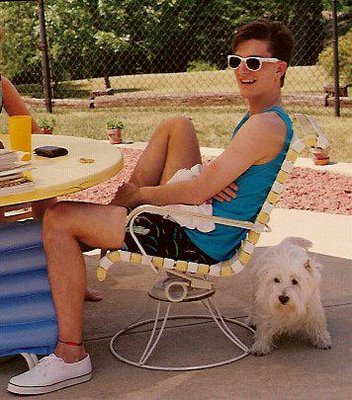
Things I had discovered in 1984: Canvas shoes from Target. The gender-bending subversiveness of wearing an ankle bracelet. White fake Ray-Bans with little black music notes all over them. Gravity-defying hair. Things I had not yet discovered in 1984: Going to a gym. Having the good sense not to wear tank tops in public. Having the good sense not to wear white fake Ray-Bans with little black music notes all over them.
My 21st birthday:
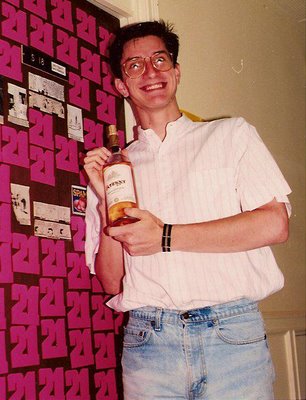
I’m not sure what’s most disturbing about this picture: the bar mitzvah clown smile, the Disney villain eyes, the dinner-plate glasses, the scarecrow neck, the weird-ass way I wore my watch on the inside of my wrist or the pink-on-white shirt that hung on me with all the sex appeal of a party dress on a toddler. The girls on my floor (Loser alert! I was living in a co-ed dorm!) had decorated my door with pink 21s. Probably to match the shirt. Or the homosexuality. I’m not sure where I got the wine, but I am sure I had only a sip of it to celebrate reaching such a milestone age. Because actually drinking a whole glass of alcohol on my 21st birthday would have been something the cool kids would do.
College graduation:
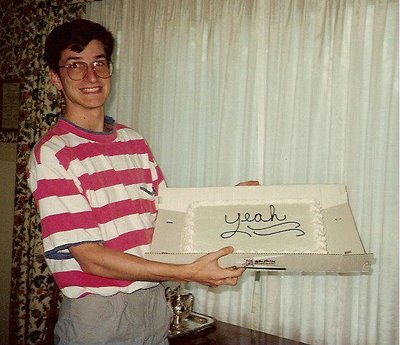
First of all, I guess I had a cute little habit of saying Yay! about situations that met my approval when I was in college. Unfortunately, Mom (who correctly thought Yay! would be fitting sentiment to express over a college graduation) and the cake decorator (who probably didn’t have an advanced degree in spelling) ended up producing a graduation cake that said yeah in my honor. Which only underscores what the rest of this picture is saying about me. For instance: The glasses. Bigger than my face. Lower than my eyebrows. I’m just a home perm and a cameo brooch away from being Sophia Petrillo. And don’t get me started on the shirt. I’d thought it was one of the coolest shirts ever when I first found it wadded up on the tumble table at the local County Seat. It was red and white, see, but it had blue stuff sewn in to the collar and sleeves (and, inexplicably, that saggy pocket) to make it look like it was layered. It was also probably a small, yet it hung on me like a Mayan burial gown on an immolated corpse. And in any case, the whole look was in direct violation of the contract I signed when they gave me my English degree: no bright colors, no perky smiles, no Sally Jesse Raphaël glasses. And no misspelled pastries.
I have bravely posted photographic proof of my young homeliness on this site, only to be met with mockery and derision from certain readers who accused me of trying to pass off cuteish pictures of myself as proof that it was sometimes challenging even for my own mother to hug me.
Well now the gloves are off. Or at least the dignity is. Whatever was left of it. Because I dug around in the darkest corners of my old photo albums and found some of the last remaining Photos of Shame that hadn’t been destroyed by me or self-exterminated in a heroic act of community service.
I scanned six pictures before I put all my albums in storage, and I’m presenting three of them to you here (in chronological order so you can more easily chart my descent into unsightliness). The other three have a theatrical theme (go figure) and qualify for their own special category of horror. Which means I have a Halloween post all ready to go. Less work for me!
In the mean time, grab your stomachs and avert your eyes, because you’re about to see some pictures of me that, when you consider the fact that I’ve never been placed in a home for frightening children, qualify my parents for sainthood.
You’ve been warned.
The summer of 1984:

Things I had discovered in 1984: Canvas shoes from Target. The gender-bending subversiveness of wearing an ankle bracelet. White fake Ray-Bans with little black music notes all over them. Gravity-defying hair. Things I had not yet discovered in 1984: Going to a gym. Having the good sense not to wear tank tops in public. Having the good sense not to wear white fake Ray-Bans with little black music notes all over them.
My 21st birthday:

I’m not sure what’s most disturbing about this picture: the bar mitzvah clown smile, the Disney villain eyes, the dinner-plate glasses, the scarecrow neck, the weird-ass way I wore my watch on the inside of my wrist or the pink-on-white shirt that hung on me with all the sex appeal of a party dress on a toddler. The girls on my floor (Loser alert! I was living in a co-ed dorm!) had decorated my door with pink 21s. Probably to match the shirt. Or the homosexuality. I’m not sure where I got the wine, but I am sure I had only a sip of it to celebrate reaching such a milestone age. Because actually drinking a whole glass of alcohol on my 21st birthday would have been something the cool kids would do.
College graduation:
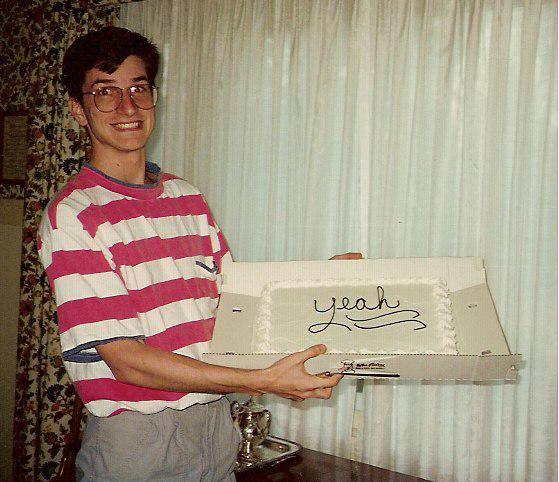
First of all, I guess I had a cute little habit of saying Yay! about situations that met my approval when I was in college. Unfortunately, Mom (who correctly thought Yay! would be fitting sentiment to express over a college graduation) and the cake decorator (who probably didn’t have an advanced degree in spelling) ended up producing a graduation cake that said yeah in my honor. Which only underscores what the rest of this picture is saying about me. For instance: The glasses. Bigger than my face. Lower than my eyebrows. I’m just a home perm and a cameo brooch away from being Sophia Petrillo. And don’t get me started on the shirt. I’d thought it was one of the coolest shirts ever when I first found it wadded up on the tumble table at the local County Seat. It was red and white, see, but it had blue stuff sewn in to the collar and sleeves (and, inexplicably, that saggy pocket) to make it look like it was layered. It was also probably a small, yet it hung on me like a Mayan burial gown on an immolated corpse. And in any case, the whole look was in direct violation of the contract I signed when they gave me my English degree: no bright colors, no perky smiles, no Sally Jesse Raphaël glasses. And no misspelled pastries.
Tuesday, February 22, 2005
Embarrassing moment #1
Afro-American Literature (as it was called at the time) has, quite frankly, a killer reading list. In one semester we’ll be covering the major works of Amiri Baraka, Richard Wright, Toni Morrison, James Baldwin … and those are just the writers I’ve heard of. I’m a junior in college, I’ve just declared my English major, and I’m ready to sink my teeth into a world of great literature and heady discussions. Really!
It hasn’t occurred to me that I might be the only white person in the class. And when I walk in that first day, I am. Until two white girls walk in a couple minutes later. I’ve never been the racial minority before, and the experience makes the class and everything we read and discuss and learn all the more profound for me.
The professor is brilliant. He peppers his lectures with names and dates and fascinating contextual histories without ever using notes. He gets his students to participate with enthusiasm—even the ones who think they’re too cool and fight him every step of the way. His influence literally transforms the way I think and write, and I hear his voice in my writing to this day.
And the things he and his reading list teach me about the black experience in America! I find myself spellbound in incredulity as I begin to understand the ubiquity of black suffering in the name of white American “freedom” and “liberty.” I weep openly as I read the stories and absorb the sociopolitical implications of the literature in our curriculum. I vow then and there that I will always be color-blind in the way I treat people.
The class is truly a transforming milestone in the way I define myself and the way I relate to my surroundings. It blows open the doors of my relatively sheltered world and it energizes me as global citizen.
But it isn’t until a year later, when I run into the professor at a staging of Ntozake Shange’s “for colored girls who have considered suicide/when the rainbow is enuf” and he offers to drive me home, that for some reason I suddenly realize—to my absolute, gut-wrenching horror—that those two white girls and I had slowly, gradually drifted toward each other and had eventually spent the semester sitting—rudely, arrogantly, cluelessly—front and center in his classroom … while our black classmates had sat behind us. In the back of the learning bus.
The professor died within a year after that ride in his car. I have never kept in touch with anyone—black or white—from that class. Fifteen years later, I still feel sick to my stomach when I think about it.
And I have nobody to apologize to.
It hasn’t occurred to me that I might be the only white person in the class. And when I walk in that first day, I am. Until two white girls walk in a couple minutes later. I’ve never been the racial minority before, and the experience makes the class and everything we read and discuss and learn all the more profound for me.
The professor is brilliant. He peppers his lectures with names and dates and fascinating contextual histories without ever using notes. He gets his students to participate with enthusiasm—even the ones who think they’re too cool and fight him every step of the way. His influence literally transforms the way I think and write, and I hear his voice in my writing to this day.
And the things he and his reading list teach me about the black experience in America! I find myself spellbound in incredulity as I begin to understand the ubiquity of black suffering in the name of white American “freedom” and “liberty.” I weep openly as I read the stories and absorb the sociopolitical implications of the literature in our curriculum. I vow then and there that I will always be color-blind in the way I treat people.
The class is truly a transforming milestone in the way I define myself and the way I relate to my surroundings. It blows open the doors of my relatively sheltered world and it energizes me as global citizen.
But it isn’t until a year later, when I run into the professor at a staging of Ntozake Shange’s “for colored girls who have considered suicide/when the rainbow is enuf” and he offers to drive me home, that for some reason I suddenly realize—to my absolute, gut-wrenching horror—that those two white girls and I had slowly, gradually drifted toward each other and had eventually spent the semester sitting—rudely, arrogantly, cluelessly—front and center in his classroom … while our black classmates had sat behind us. In the back of the learning bus.
The professor died within a year after that ride in his car. I have never kept in touch with anyone—black or white—from that class. Fifteen years later, I still feel sick to my stomach when I think about it.
And I have nobody to apologize to.
Subscribe to:
Posts (Atom)